Multimedia Challenge: Comics
Photo by Brett Jordan, Unsplash
Grown-up Guide to Clean Hands
Subtitle: Meet Georgia and her little sister Holly, two tiny heroes teaching adults the importance of handwashing.
Updated: February 20, 2026 Author: Chelsea Kirkpatrick
Introduction
It is a common assumption that we wash our hands frequently. However, in my experience working in a hospital, adults frequently forget to wash their hands after sneezing, coughing, and using the washroom. As a society, it is taboo to say you don’t wash your hands but it is also uncomfortable to question someone’s hand washing practices. Why is it that we are comfortable discussing hand washing with children but not adults?
The characters, Holly and Georgia, are based on my own children. Georgia is the narrator of the comic. I chose to use a child rather than an adult as children are more approachable and an adult narrator could come off as patronizing. Reminding people to wash their hands is an uncomfortable task so I tried to add some humour to make the comic less confrontational.
My goal for this project is to create an educational tool that will resonate with adults and encourage them to wash their hands. I also think it is a gentle reminder of when to wash your hands rather than assuming everyone knows all the scenarios.
Final Design Coming Soon
The Process
DESCRIBE THE CHALLENGE:
Many people are taught to wash their hands in childhood. However, adults are often observed not washing their hands after using the bathroom, coughing, blowing their nose. Adult behaviour is not corrected because it is uncomfortable. This comic tries to break the taboo of adult hand washing in a fun and educational way.
CONTEXT AND AUDIENCE:
The intended primary audience are adults visiting common public spaces where they can come into contact with other people. Possible sites include hospitals, schools, public washrooms, libraries, and airports. Children are the secondary audience as they may be able to understand the comic but it is not geared toward children specifically.
POV STATEMENT:
Adults needs to wash their hands frequently so that they don’t spread germs that make people sick.
LEARNING OBJECTIVES:
The objective of this project is to improve everyday hand washing practices of adults. By providing a funny comic to read I hope it will make people think about their own hand washing practices and how they can improve. I want to correct misunderstandings people have about when and why it is so important to wash your hands. This is a concept most people learn in childhood but as adults we can use a refresher.
The Plan
IDEATION:
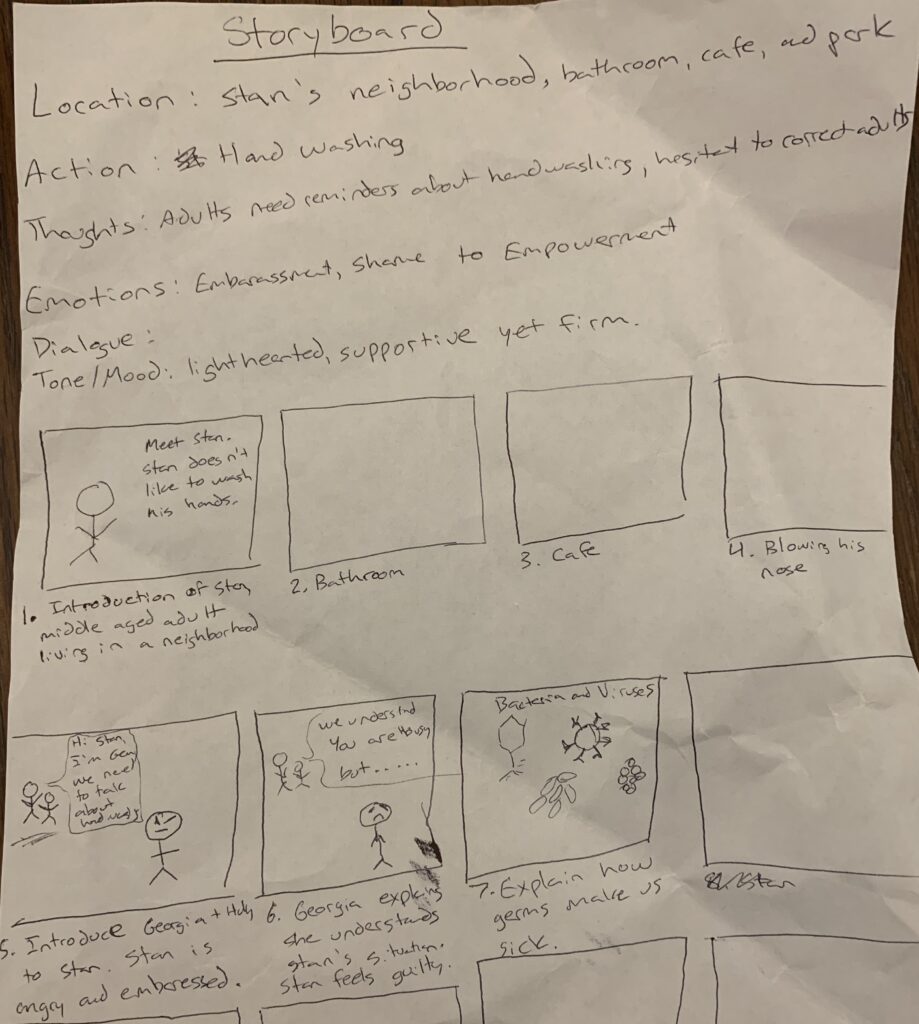
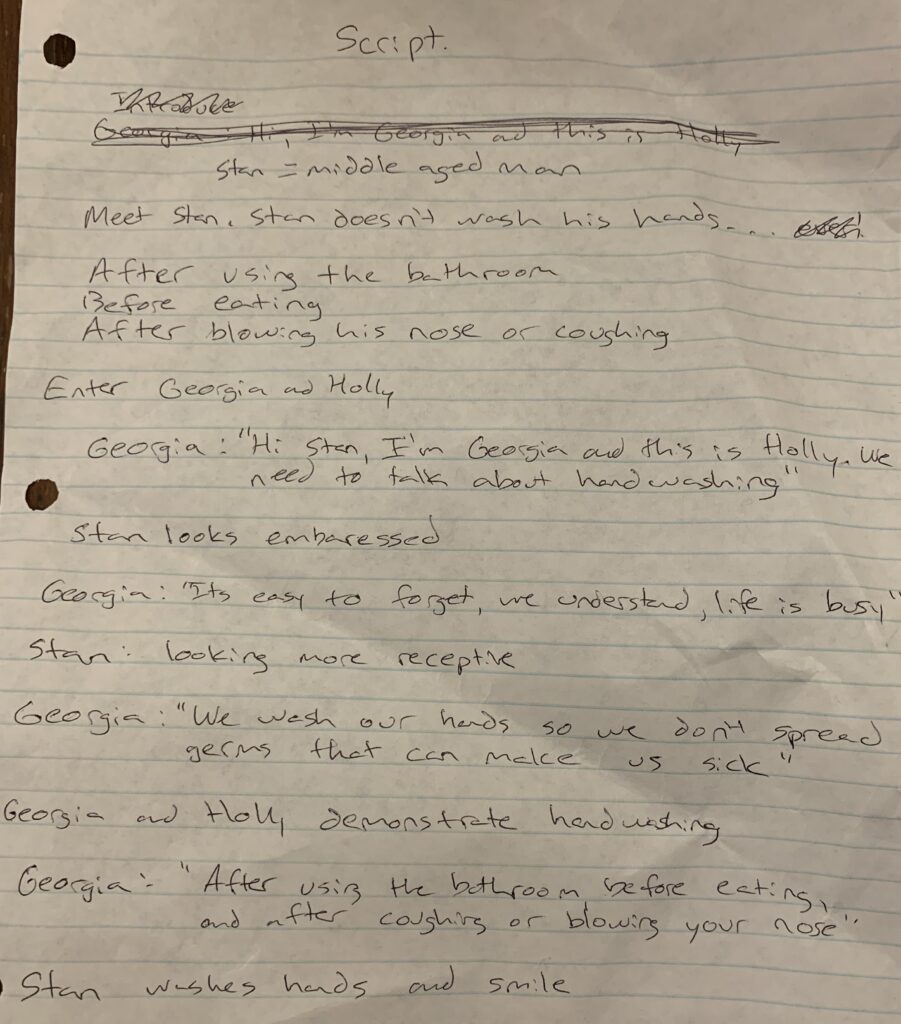
I took inspiration from my work in Infection Control to identify my intended result. I then utilized Backward Design Process to incorporate the steps needed to reach the end goal. This resulted in a comic strip that walks the learner through how/when to wash their hands. Initially, I jumped into immediately designing a comic strip on Canva. I then took a step back and started storyboarding and journey mapping with a pen and paper. Once the story was completed, I wrote out the script, created the characters then returned to Canva and created the prototype.
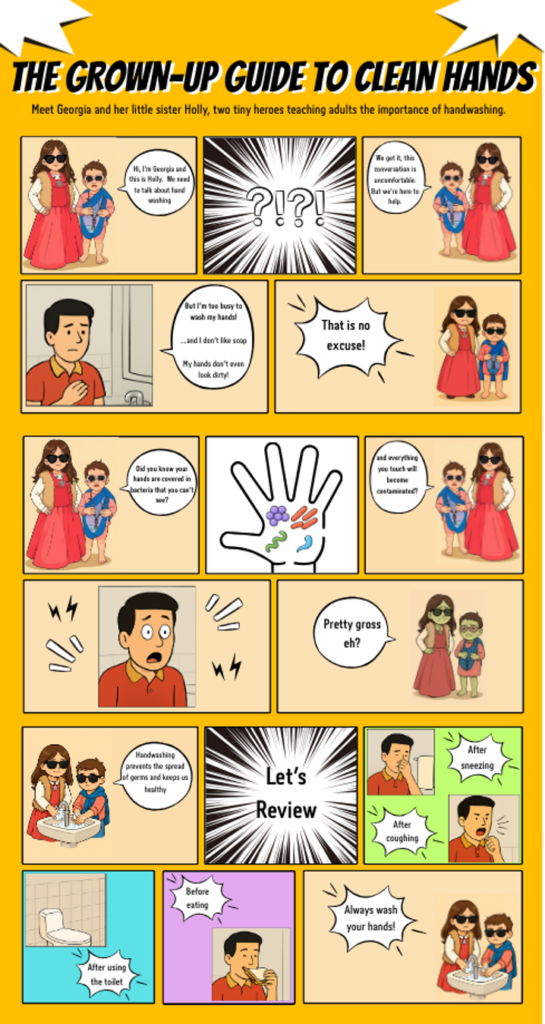
My current prototype follows the journey of an adult that doesn’t wash his hands. The adult is approached by Georgia and Holly, two little girls that want to help them understand why they need to wash their hands.
STORYBOARD OR SCRIPT:
THEORY APPLIED:
Dual Coding Theory: Dialogue was always followed by a relevant image. This was done to stimulate both verbal and non-verbal processing centres in the brain leading to better long term memory storage.
Redundancy Principle: To reduce extraneous cognitive load, I limited each frame of the comic to graphic and text only or graphic and narration only, never all three.
Signalling Principle: Key moments of hand washing were placed in large boxes to signal to the learner their importance. This reduced cognitive load as the learner didn’t have to discern essential information from non-essential.
Storytelling Principles: I incorporated the following into the comic to improve the storyline: Location (a bathroom), Action (hand washing), Thoughts (why do I need to wash my hands?), Emotion (shock, disgust, embarrassment, hope), Dialogue (narrator tells the story).
The Prototype
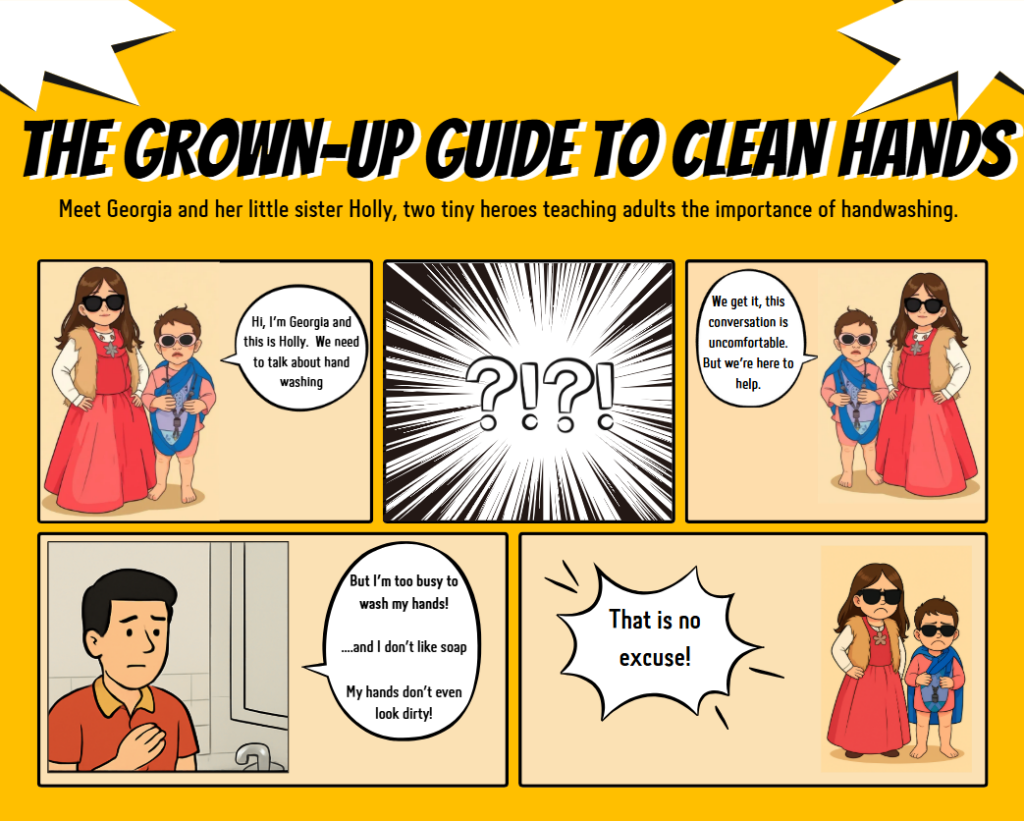
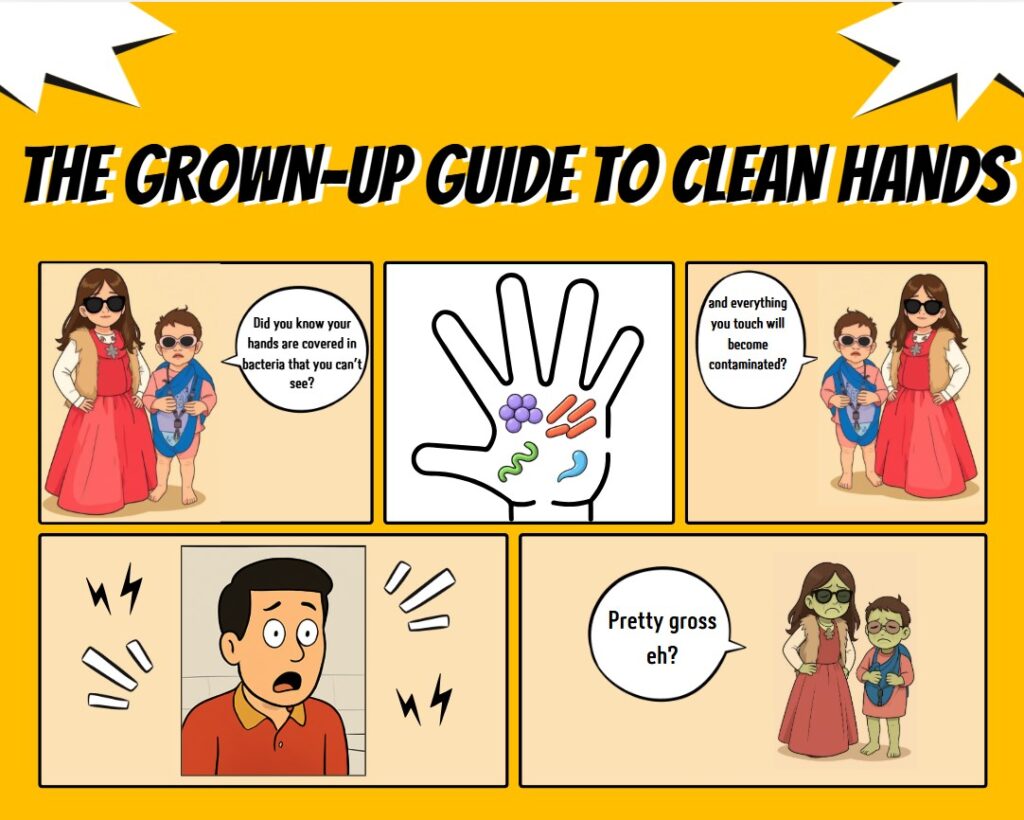
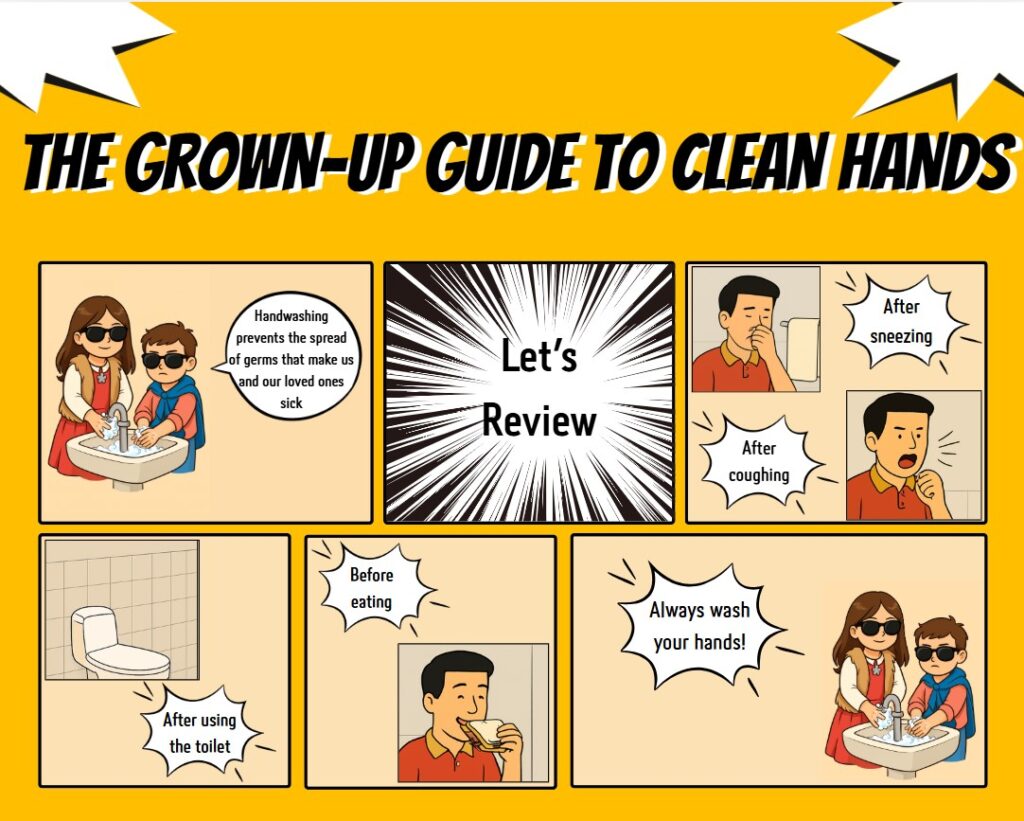
CANVA AI was used to generate images from a photo I took of my children.I uploaded a photo of them to Canva and used the Cartoonify feature to create the characters.
I purposely left the adult in the comic unnamed and gender neutral. The characters of Georgia and Holly are white, the same as the original children in the photograph.
PEER FEEDBACK:
The comic was peer reviewed by Rebeka (@rebekahomolkova) and Khoa (@lkhoa). Both reviewers appreciated the authenticity and relatability of the comic through characters based off my own children and handwashing being an everyday topic. Both also noted the visual style as easy to follow due to the uncluttered and simple design of the panels. Khoa and Rebeka both suggested combining the panels for better continuity. This could be done by indicating how many panels there are or incorporating the 3 panels into one continuous vertical strip.
Rebeka remarked that storytelling principles were evident; an introduction followed by a clear progression of ideas. In the planning process she observed use of backward design process allowed the objectives to be fully formed before jumping into creating.
Khoa noted that awareness that adults overlook hygiene showed intention and made the idea stronger. He also appreciated the step-by-step planning in developing script and tone. Khoa suggested connecting the design choice of using picture and text to a specific multimedia concept.
Reflect and Refine
What worked well?
It was very gratifying to hear that my use of humor, character design, and topic resonated with both peer reviewers. During the design process I was worried my script would be misinterpreted or misunderstood so it was reassuring to hear it was not. If text and image are not used together optimally then the learner will have a negative learning experience (Yousman, 2015).
Storytelling was an important element of this comic (Glonek et al., 2014). I found it was easier to create a script using storytelling principles rather than focusing on instruction. Having characters
What would you change?
I struggled with the preparation and planning phase of design. I drew a very simple storyboard without much detail and as a result ended up making three different Canva templates and merged them into the final prototype. Next time I will try journey mapping, instead of storyboarding, as a planning tool (Granchelli, 2025 September 14). I am a visual learner and I like to have tools in front of me to change and alter what I am picturing in my head so having a journey mapped will keep my objectives consistent but give me the freedom to change the visuals throughout the process.
What revisions you included in your revised prototype.
Both peer reviewers expressed feeling a disconnect between the panels so in my revised prototype I will be combining the panels into a single vertical comic strip. Rebeka also suggested using subtle visual signalling to highlight the most important learning moment. This was achieved by having a different background color on each panel containing a key learning moment. In this case, washing hands after coughing and sneezing, after using the bathroom, and before eating.
What issues were raised, and how would you address them?
A limitation of using this type of multimedia is it is not universally accessible (Granchelli, 2025 November 2). I tried to use contrasting colors to help those with visual impairments but ultimately the lack of audio makes it impossible for those who are visually impaired to access it. Neither peer reviewer disclosed any visual impairments so it mustn’t be assumed the prototype was universally accessible.
A strength of this type of multimedia is the ability to engage the learner through dual coding by having text and picture in the same panels (Granchelli, 2025 September 5). Stimulating both verbal and non-verbal processing centres in the brain leading to better long term memory storage and, as both peer reviewers noted, made the comic more endearing and more memorable.
Final Artifact
References:
Glonek, Katie L. & Paul E. King (2014) Listening to Narratives: An Experimental Examination of Storytelling in the Classroom, International Journal of Listening, 28:1, 32-46, DOI: 10.1080/10904018.2014.861302
Granchelli, A. (2025, September 5). Models of Active Learning. University of Victoria: Educational Technology. https://edtechuvic.ca/edci337/2025/10/19/models-of-active-learning/
Granchelli, A. (2025, September 14). Storytelling. University of Victoria: Educational Technology. https://edtechuvic.ca/edci337/2025/09/14/storytelling/
Granchelli, A. (2025, November 2). Accessible Multimedia. University of Victoria: Educational Technology. https://edtechuvic.ca/edci337/2025/11/02/accessible-multimedia/
Yousman, B. (2015). The Text and the Image: Media Literacy, Pedagogy, and Generational Divides. J. Frechette & R. Williams (Eds.), Media Education for a Digital Generation (pp. 157–170). Routledge. https://doi.org/10.4324/9781315682372